·8 min read
Social Networking Isn't About Followers. It's About Who You Become.
Social networking isn't a contacts game — it's an environment game. 87 years of Harvard research explains why the people you choose reshape who you become.
TL;DR: Social networking isn't about accumulating contacts — it's an environment game. The relationships you choose reshape your identity, expectations, and outcomes more than any skill you can acquire. Quality beats quantity. Always.
The Cliché That's Technically True but Practically Wrong
Social networking has a marketing problem.
"Your network is your net worth." You've heard it so many times it's stopped meaning anything. People attend events to collect business cards. They send cold LinkedIn DMs that open with "I wanted to reach out." They optimize for follower counts and connection numbers as if a larger spreadsheet means a bigger life.
That's not social networking. That's performance.
The real version starts with a harder question: who are the people in your orbit right now, and are they raising your ceiling or cementing your floor?
Because the evidence — 87 years of it — says your relationships aren't just a career asset. They're the primary input determining who you become.
What 87 Years of Research Actually Says
The Harvard Study of Adult Development is the longest in-depth study on human happiness ever conducted. Started in 1938 with 724 participants, it now tracks over 2,500 people across three generations.
The finding is deceptively simple: good relationships are the strongest predictor of a long, healthy, and happy life — stronger than income, stronger than fame, and stronger than cholesterol levels or blood pressure at age 50.
"The clearest message is this: Good relationships keep us happier and healthier. Period."
— Robert Waldinger, Harvard Medical School, Harvard Gazette, 2025
The researchers also found that relationship quality — not quantity — was the signal that mattered. Participants with large social circles were sometimes deeply lonely. Others with two or three close relationships lived well into old age, sharp and satisfied.
Waldinger's team also found that loneliness is as physiologically dangerous as smoking half a pack of cigarettes a day. The body reads isolation as threat. Low-level fight-or-flight. Chronic stress hormones. Accelerated physical decline.
We evolved to be social. Disconnection isn't just sad — it's costly.
Your Environment Is Who You Are
Moving to Southeast Asia shifted something I didn't expect.
It wasn't the cost of living or the co-working spaces. It was the people. In a concentrated digital nomad environment — Chiang Mai being a strong example — you're surrounded by people who've made a fundamentally different choice. Who've rejected the script of office jobs and 30-year mortgages and decided to build life differently. You start meeting people with entirely different values, different life views, different reference points for what's possible.
You absorb that. Without trying.
When everyone in your orbit is optimizing their business, reading deeply, experimenting, building — that becomes your baseline. The ceiling for what feels possible quietly rises over months. The things you thought required special permission start looking like ordinary moves.
The reverse is also true. If your environment is people who are comfortable, checked out, or on autopilot, that comfort becomes gravity. You stop noticing you're not moving.
Nicholas Christakis and James Fowler's research in Connected showed that behaviors — happiness, habits, even a sense of purpose — spread through social networks across three degrees of separation. The people your friends know affect you, even without direct contact.
You are not separate from your social environment. You are, in large part, an output of it.
Weak Ties Open Doors. Strong Ties Change You.
There's a distinction worth making clearly.
Mark Granovetter's 1973 weak ties research found that most job opportunities arrive through acquaintances — not close friends. A LinkedIn-backed randomized experiment (Rajkumar et al., Science, 2022) tracked 20 million people over five years and 600,000 new jobs and confirmed it: weak ties increase job mobility more than strong ties, especially in digital industries. Acquaintances move in different circles. They carry information you don't have access to.
This is also why distribution and access matter more than most people think — your extended network is the mechanism by which opportunity finds you.
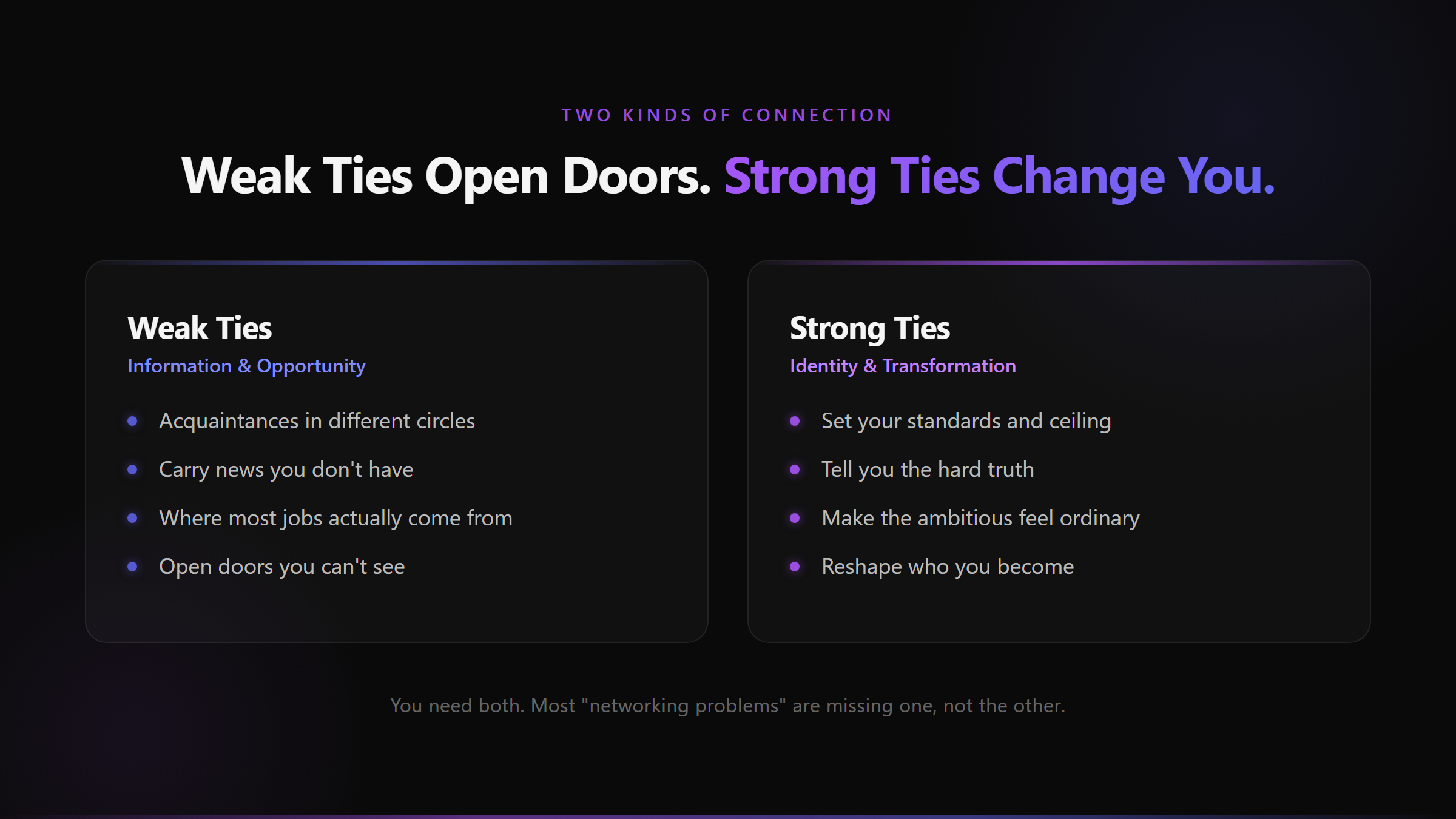
But weak ties open doors. Strong ties change who you are.
Close relationships set your expectations, your standards, your reference points. The friend building a business makes building a business feel ordinary. The person who stays calm under pressure makes calmness feel achievable. The relationships where someone tells you the hard truth — where you can be honest in both directions — those are the ones that actually reshape you.
- Weak ties: information and opportunity
- Strong ties: identity and transformation
You need both. Most people with a "networking problem" are missing one, not the other.
How to Audit Your Circle
Three questions worth sitting with honestly:
1. Who raises your floor?
Notice whether you feel like you're operating at a higher level after spending time with someone — or lower. The people who raise your baseline for what's acceptable are worth protecting.
2. Who tells you the truth?
Compliments are plentiful. Honest feedback is rare. The friend who tells you your plan is weak, your content is average, that you're repeating a mistake — that person is more valuable than ten people who agree with everything. Don't trade honest friction for comfortable agreement.
3. Are you consistently the most ambitious person in your orbit?
Not as a flex — as a warning sign. If you're always the one pulling others forward and no one's pulling you, your environment is capping you. Find rooms where you're mid-table or slightly behind the pace. That's where real growth happens.
The goal isn't ruthless pruning. It's intentionality about where you invest energy and where you seek proximity.
The Shift That Actually Matters
Most social networking advice is tactical: go to more events, follow up faster, reach out to more people. That's the follower count mindset applied to human connection.
The shift that actually matters is treating your social environment the way you'd treat any high-leverage input. Not as a task to complete but as a system to design.
You are, right now, being shaped by the people around you — their assumptions, their tolerance for mediocrity, their ceiling for what's possible. That's happening whether you're paying attention to it or not.
The question is whether you're choosing that input deliberately or inheriting it by default.
A few relationships carry the power to change your trajectory. One person who sees something in you that you don't yet see in yourself. One introduction into a room you couldn't have accessed alone. One relationship where the standard is high enough that you have to grow into it.
The most successful people don't have the most contacts. They're relentlessly intentional about the relationships they protect and the environments they put themselves in. That instinct — the ability to connect, trust, and build — is one of the few things that compounds over time and doesn't get commoditised.
That's the real definition of social networking.
Frequently Asked Questions
Does the quality of your relationships really affect career outcomes?
Yes — more than most people expect. The Harvard Study of Adult Development (87 years, 2,500+ participants) found relationship satisfaction to be a stronger predictor of life outcomes than cholesterol or blood pressure at age 50. The people around you shape your habits, your expectations, and your access to opportunity in ways that compound over years.
Is it better to have a large network or a small, tight one?
Neither size alone predicts outcomes. Research consistently shows quality matters more. A small number of high-trust relationships — where there's honesty, investment, and genuine challenge — outperforms a large, shallow contact list every time. Most people need both weak ties (access) and strong ties (transformation), just in different ratios.
What's the actual difference between weak ties and strong ties in social networking?
Weak ties (acquaintances, extended contacts) are more likely to carry new information and job opportunities outside your current circle. Strong ties (close friends, mentors) shape your identity and hold you to a standard. A 2022 LinkedIn experiment tracked 20 million people and confirmed weak ties drive job mobility — but strong ties are what change who you become.
How does where you live affect the quality of your social network?
Significantly. Social contagion research shows behaviors, expectations, and attitudes spread through networks up to three degrees of separation. Living in an environment where the people around you operate at a level you aspire to — a city, co-working space, or community — is one of the highest-leverage inputs for who you become over a two to five year horizon.
How do I find better relationships if I'm starting from scratch?
Focus on environments before people. Join a community built around something you're genuinely working on. Repeated casual contact with people who share your goals is the natural starting point for deeper relationships. It's harder to force individual relationships than to place yourself in an environment where the right ones emerge naturally.