·8 min read
The AI Sales Gap: Why Builders Ship and Never Sell
AI made building free and selling brutal. Why AI sales is the scarce skill in 2026 — and why I started Closewright to teach builders how to close.

TL;DR
AI sales is the discipline of selling in a market where building the product is no longer the hard part. In 2026, founders' top fear flipped from technical complexity to customer acquisition — yet most are retreating from distribution at the exact moment it became the whole game. I started Closewright to teach builders the one skill the models can't do for them.
I want to tell you about the moment I decided to build something new.
I was looking at my own numbers. Roughly 5,000 cold emails sent to local service businesses. A hundred SMS follow-ups. Zero replies. Not a bad reply rate — zero. Meanwhile I could stand up a complete, production-grade website in an afternoon, deploy it, and have it indexed by morning.
That gap is the whole story of business in 2026. I had never been more capable of building and never less capable of getting someone to care. So I started Closewright: a sales education brand for people who can build the thing but freeze the moment they have to sell it.
The Fear Just Flipped, and the Data Is Blunt About It
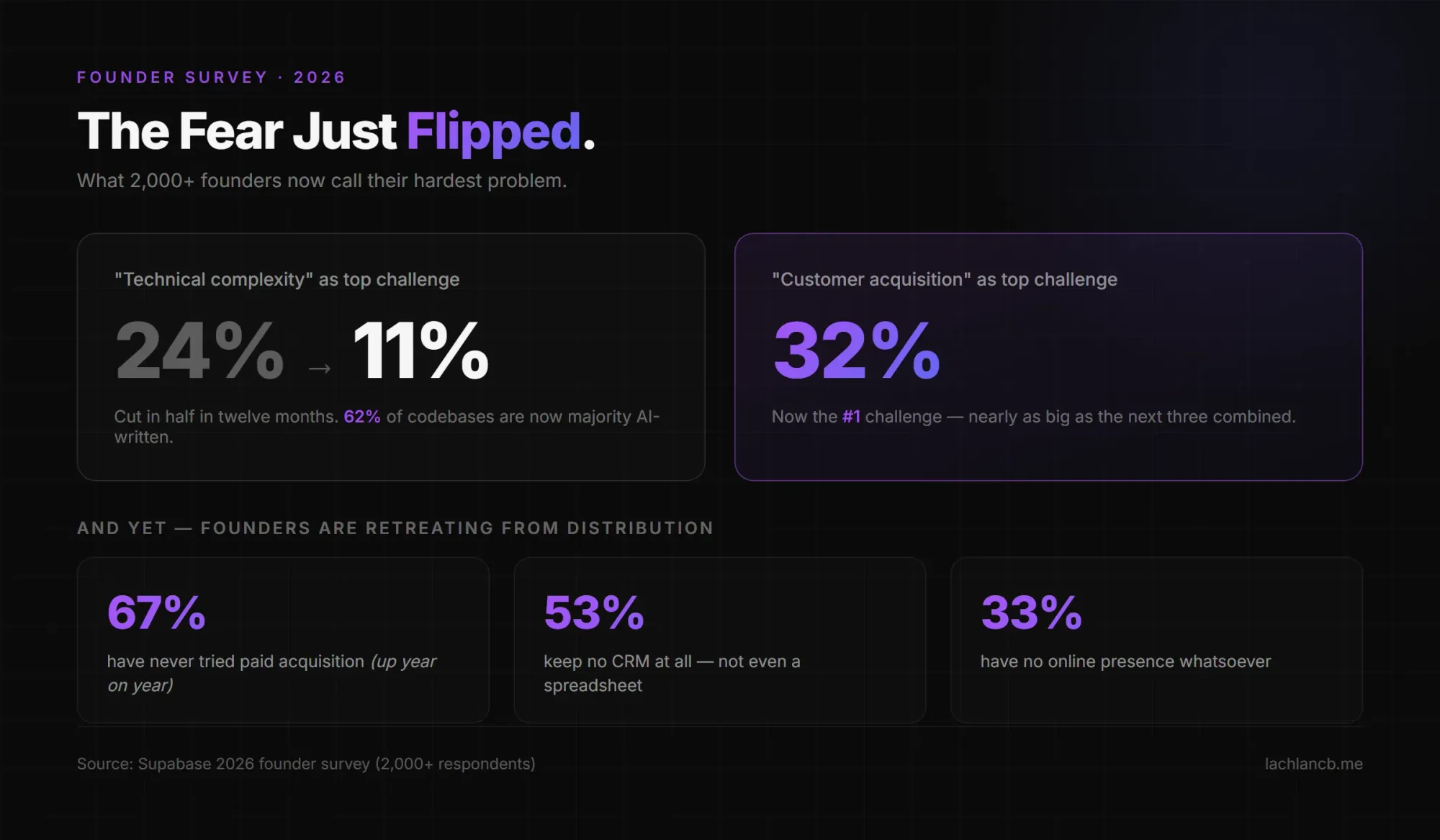
Something measurable happened this year. In Supabase's 2026 survey of more than 2,000 founders, "technical complexity" as the top business challenge fell from 24% to 11% — cut in half in twelve months. What replaced it at the top of the list was customer acquisition, now the number one challenge for 32% of founders.
The reason sits in the same dataset: 62% of those startups now have a majority of their codebase written by AI, and 41% are somewhere between 76% and 100% machine-written. Only 2% still write everything by hand.
Read those two facts next to each other. Building got easy. Selling got scarier. One founder in that survey put it more plainly than I could: "Building is the easy part. Distribution is the hardest. There is no unique idea or product anymore."
This isn't new wisdom — I've argued before that building isn't the moat anymore, distribution is. What's new is that the market finally agrees, in numbers, all at once.
Builders Are Running From the Thing They Say They Fear
Here's the part that made me want to teach rather than just write.
In the same survey where getting customers became the top fear, 67% of founders said they had never tried paid acquisition — a figure that went up from the previous year. 53% of those with a real go-to-market motion keep no CRM at all, not even a spreadsheet of names. And 33% report having no online presence whatsoever, up five points in a year.
They diagnosed the disease and then threw out the medicine.
I understand it, because I've done it. Building gives you a win every twenty minutes. A component renders, a test goes green, a deploy succeeds. Selling gives you silence, then rejection, then more silence. So you retreat into the room where the machine makes you feel powerful and you call it work.
The uncomfortable truth is that a build session with no buyer at the end of it is procrastination with better tooling. When 61% of these companies are solo founders, there's nobody across the table to point out you shipped four features this week and spoke to zero humans.
Sales Is a Craft, Not a Personality Trait
The story most technical people tell themselves is that selling is a personality you either have or don't — that it belongs to a louder, slicker kind of person, and it's faintly dishonest besides.
That story is expensive and it's wrong. Selling is a technical discipline with mechanics you can study the same way you'd study a database schema: qualification, positioning, pricing to value, objection handling, follow-up sequencing, the close. Every one of those is a learnable component with observable inputs and outputs.
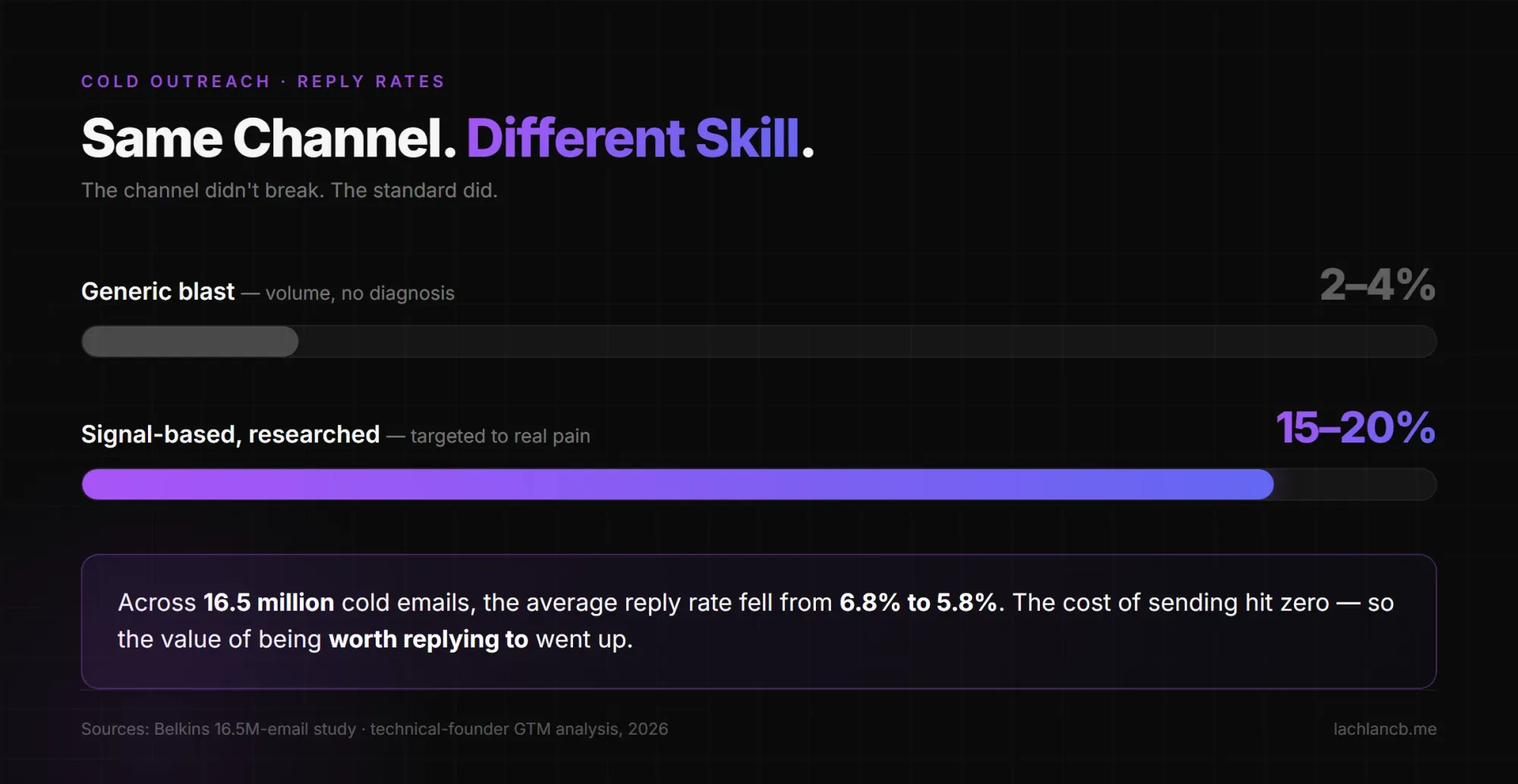
The evidence backs the craft framing. Cold email reply rates fell from 6.8% in 2023 to 5.8% in 2024 across 16.5 million sends — but well-researched, signal-based outreach still reports 15–20% reply rates against 2–4% for generic blasts. Same channel. Same year. The variable is skill.
My own 5,000 emails weren't beaten by the algorithm. They were beaten by the fact that I was talking to people who felt no pain about the thing I was selling. That's not a volume problem or a tooling problem. That's a diagnosis problem — the first mechanic in the craft, and the one I'd skipped.
Why AI Raises the Price of This Skill Instead of Lowering It
The intuitive assumption is that AI will sell for you. It won't, and the reason is structural.
AI collapsed the cost of execution — research, enrichment, drafting, sequencing. Work that took three to five hires in 2023 now runs from one laptop. But it hasn't touched positioning judgment, taste, trust, or the human core of an early sales conversation. When execution becomes free, it stops being a differentiator, and everything upstream of it — judgment — becomes the entire premium.
There's a second effect that's easy to miss. When everyone can ship in days, shipping stops being a signal. Your prospect isn't choosing between you and nothing. They're choosing between you and forty things that look identical from the outside. The only tiebreaker left is whether they trust the person asking.
That's why I keep landing on the same conclusion: sales is the last skill AI can't touch. Not because a model can't write a good email — it can, better than most people. But because someone still has to decide who's worth emailing, what they actually want, and what it's worth. That's judgment, and judgment is priced by scarcity.
What Closewright Is — and What It Isn't
Closewright teaches technical founders, indie hackers, and freelance developers how to sell what they've built. Mechanics, not motivation.
What it is: real scripts, real teardowns, real frameworks. What a cold opener should actually say. How to price against value instead of against your own GitHub subscription. What to do with the follow-up after they go quiet. Specific situations with specific outcomes.
What it isn't: hustle theatre, borrowed guru scripts, or a course promising that closing is a mindset. There's plenty of that already, and it's part of why smart builders wrote off the entire category.
I'm also not teaching this from a mountaintop. I'm teaching it from the arena — from cold calls that went badly, from an email campaign that returned nothing, and from the week I discovered a single afternoon in a room full of people out-produced months of automated outreach. That gap between what I built and what I sold is the curriculum.
And there's an opening here, which is the genuinely optimistic part. If a third of your competitors just went quiet, and two-thirds have never tried to be seen, the bar for getting noticed is lower than it looks. Their silence is the opportunity.
Frequently Asked Questions
What is AI sales?
AI sales refers to selling in a market where AI has collapsed the cost of building and executing, making judgment the scarce input. It covers using AI to handle research, drafting, and sequencing, while the human retains positioning, qualification, pricing, and trust-building — the parts models can't do.
Why do technical founders struggle to sell?
Because building offers fast, certain feedback and selling offers slow, uncertain rejection. Founders also mistake product quality for market demand. The most expensive errors are building before selling, underpricing against personal-software anchors, and treating distribution as a post-launch afterthought.
Can AI replace salespeople?
Not at the early stage. AI lowers execution cost but hasn't solved positioning, taste, or trust. Cold-email reply rates declined even as AI-generated outreach flooded inboxes — evidence that more automated volume makes human judgment more valuable, not less.
How do I start selling if I've only ever built?
Start with diagnosis, not volume. Talk to twenty people in your target market about their problem before pitching anything. If they don't describe the pain unprompted, you have a targeting problem no amount of outreach will fix. Keep a written record of every conversation.
Is cold outreach dead in 2026?
No, but generic outreach is. Reply rates fell to 5.8% across 16.5 million sends, while tightly targeted, signal-based sequences still report 15–20%. The channel didn't break. The cost of sending hit zero, so the value of being worth replying to went up.
The Part That Doesn't Change
Every few years a technology arrives and resets which skills are scarce. AI reset building. It made a competent developer out of anyone patient enough to prompt well, and it made the product itself a commodity.
What it didn't reset is the oldest transaction there is: someone has a problem, someone else can solve it, and one of them has to open their mouth first.
That's the skill I'm betting the next few years on. Not because it's fashionable — it isn't — but because it's the one part of the stack that hasn't been automated, and the one most builders are actively running from. When everyone flees the same room, that's usually the room worth standing in.