·7 min read
No One Is Safe From AI. Here's What Survives.
AI is automating coders, support, and analysts. The one skill it can't touch is AI decision making — taste, judgment, and knowing which lever to pull.
TL;DR: AI decision making is the human skill of choosing what to build, what to ship, and what to ignore — the one capability large language models can't replicate even as they automate the work itself. Coders, support reps, and analysts are watching their tasks get absorbed. Skills are no longer the moat. Taste, judgment, experience, and knowing which lever to pull are. Here's how to stay valuable.
No One Is Safe — And That's the Honest Starting Point
For twenty years the advice was simple: learn a hard skill, get paid for it. Learn to code. Learn design. Learn copywriting. That deal is breaking.
I run my whole agency from a terminal now. The thing that used to need a team — a backend dev, a designer, a writer — I do with an LLM and a few good decisions. If I can do that, so can the company that was paying those people.
This isn't a doom post. It's a relocation notice. The value didn't disappear. It moved. And if you don't move with it, you get left holding a skill nobody's buying anymore. I wrote about this shift before in Skills Are Not Important Anymore. This is the harder follow-up: nobody is safe — so what do you do about it?
AI Is Coming for the Builders First
The people who build things are getting hit first and hardest. That includes the ones who felt safest.
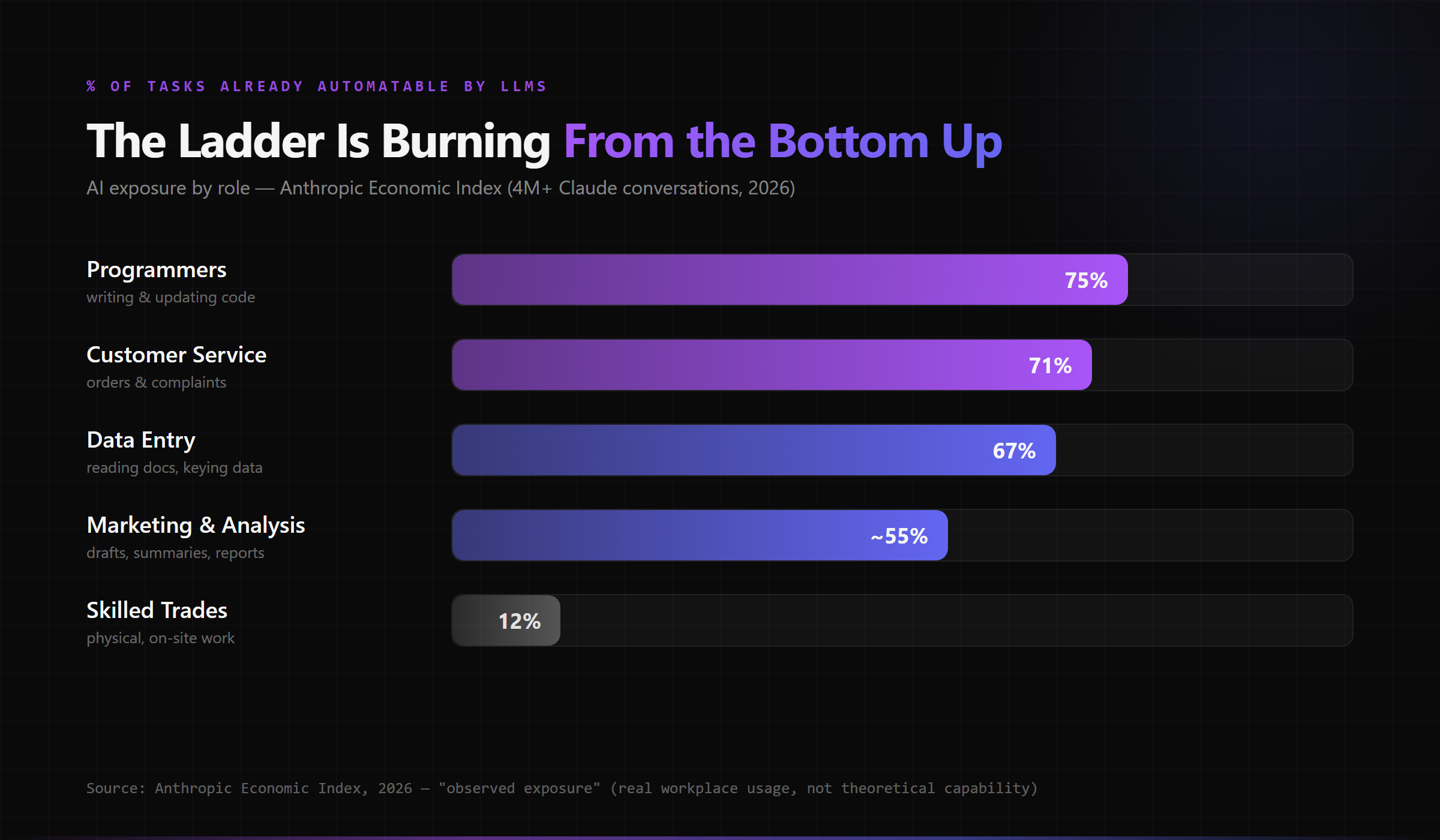
Anthropic studied over four million real Claude conversations and found programmers at the top of the exposure list — roughly 75% of their tasks are already being automated. Not "could be one day." Already.
The job market backs it up. The Stanford AI Index 2026 found employment for software developers aged 22-25 has fallen nearly 20% since 2024 — while older developers' headcount kept growing. Google's CEO says 75% of the company's new code is now AI-generated. In Q1 2026 alone, over 92,000 tech workers were laid off, and Challenger Gray attributes about 48% of those cuts directly to AI restructuring.
Read that again. The skill people were told to learn to be "future-proof" is the one being eaten first.
It's Not Just Coders. The Whole Ladder Is Burning.
Coding is the headline, but the fire is wider than that.
The same Anthropic data puts customer service reps and data entry workers right behind programmers — around 67% of their tasks already covered. Anthropic's own CEO, Dario Amodei, predicts AI could eliminate up to 50% of entry-level white-collar jobs within five years. The World Economic Forum projects 83 million jobs displaced against 69 million created by 2027 — a net loss of 14 million through the transition.
Notice the pattern. It's not "low-skill" work going first. It's codified work — anything that's a learnable procedure with a right answer. Writing boilerplate. Drafting a reply. Summarizing a report. If your job is "I know how to do the steps," the steps are now free.
That's the part most people miss. The thing being destroyed isn't intelligence. It's execution as a job.
So What Actually Makes You Valuable Now?
When everyone can produce, the value moves to knowing what's worth producing. That's it. That's the whole shift.
Generation was never the rare part — selection was. As one creative director put it, the moat is "being the selector in a world of infinite generation". AI can give you ten options in three seconds. It can't tell you which one is right for this audience, this moment, this brand. That's taste. And taste is the accumulation of every judgment call you've ever made.
A marketing leader recently wrote that after years of hiring for attitude, he now hires for taste — "the skill of knowing what good looks like, if something is worth building, and if it will connect with people." Because the bottleneck stopped being production. It's now the ability to consistently decide what should and shouldn't ship.
This is the same reason sales survives when execution doesn't. Both run on something a model can't fake: read the room, weigh the trade-off, make the call.
Skills Are Cheap. Decisions Are Expensive.
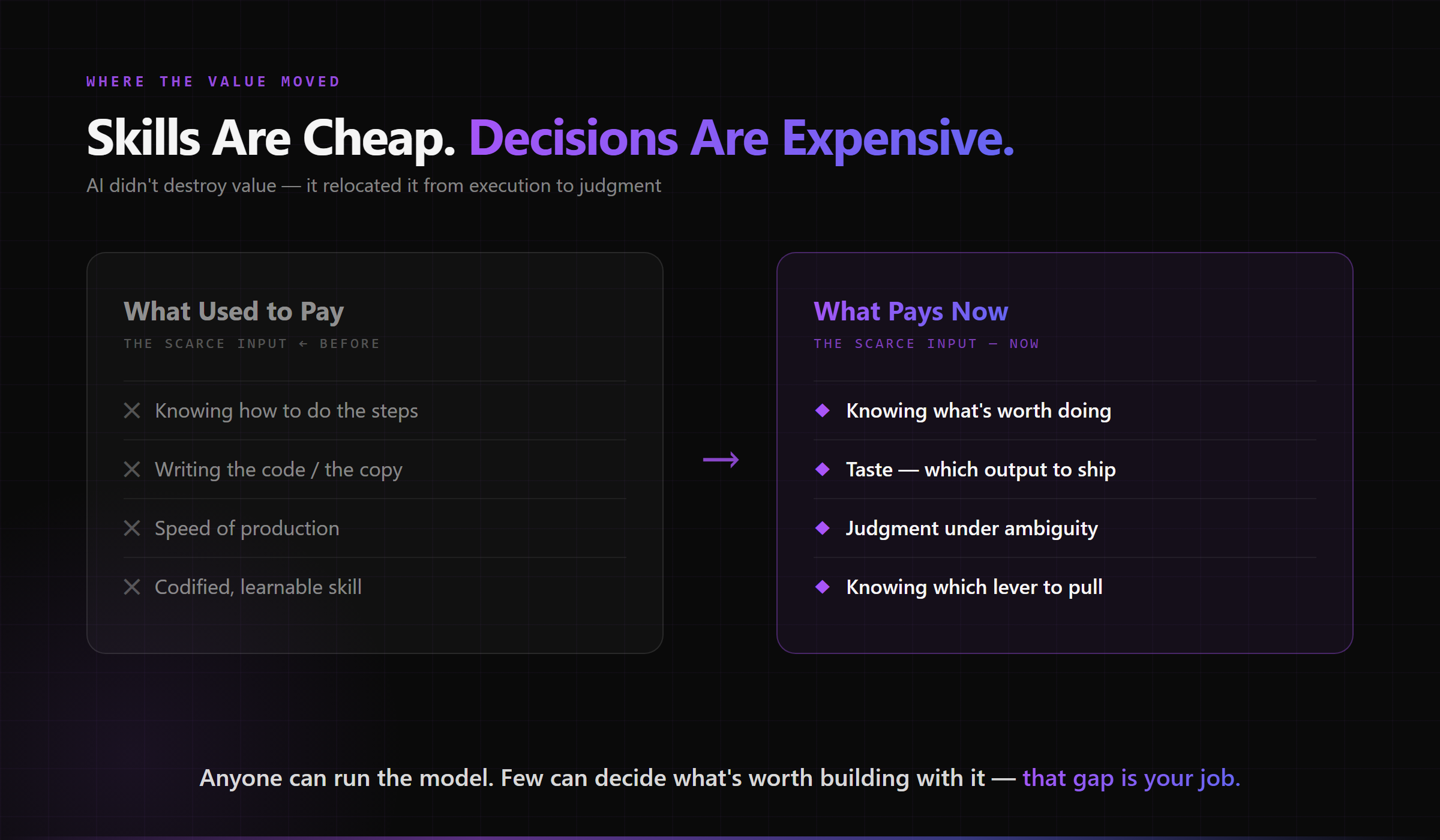
Here's the reframe that matters most: we've flipped which input is scarce.
For decades, codified knowledge was the rare thing and judgment was assumed to be plentiful. AI inverts that. As the AEI put it, "codified knowledge is now abundant... judgment has become the scarce input." The OECD found the most in-demand skills in AI-exposed jobs aren't technical at all — they're managerial: weighing priorities and exercising practical judgment. The Dallas Fed even found experience premiums rising in AI-exposed work, not falling.
This is what good AI decision making actually looks like. You stop being the person who does the task. You become the person who decides which task matters, points the LLM at it, and judges whether the output is any good. The leverage isn't the tool. It's knowing which lever to pull.
Anyone can run Claude Code now. Few can decide what's worth building with it. That gap is your job. I've argued before that learning has become a form of procrastination — the edge now is deciding and executing, not studying.
How to Survive (Do These)
You don't survive this by learning faster. You survive by relocating your value. Concretely:
- Build taste on purpose. Expose yourself to a high volume of good and bad work in your field until you can feel the difference instantly. Taste is trained, not born.
- Keep a decision log. Write down what you chose, what you rejected, and why. This sharpens your judgment and — bonus — makes your taste machine-readable so AI can match it.
- Become the selector. Stop competing with AI on output speed. Compete on judgment quality. Generate ten versions, then be the one who confidently kills nine.
- Use LLMs as leverage, not as a crutch. Point powerful models at analysis, drafting, and grunt work. Keep the deciding for yourself.
- Get close to outcomes. Skills are abstract; results aren't. Tie your value to a result a business cares about, not a task it can automate.
No one is safe with AI — if "safe" means a skill you can hide behind. But if you've spent years building judgment, you're holding the one thing that's getting more valuable, not less.
The machines got good at making everything. They still can't decide what's worth making. That's your job now. Take it.
FAQ
What is AI decision making?
AI decision making is the human skill of directing AI tools through judgment — choosing what to build, evaluating what the model produces, and deciding what to ship or kill. As LLMs automate execution, this becomes the primary source of professional value.
Which jobs are most at risk from AI?
Roles built on codified, procedural tasks. Anthropic's data shows programmers (~75% of tasks automated), customer service reps, and data entry workers most exposed, with entry-level white-collar roles broadly at risk over the next five years.
Will AI replace software engineers completely?
Not completely — but unevenly. Entry-level developer employment has fallen ~20% since 2024, while senior and architectural roles keep growing. AI is removing the bottom rung of execution while raising demand for judgment and system design.
How do I stay valuable in the age of AI?
Move from execution to judgment. Build taste through high-volume exposure, keep a decision log, become the selector who chooses among AI outputs, and tie your value to business outcomes rather than automatable tasks.
Is "learn to code" still good advice?
As a guaranteed paycheck, no. As a way to understand systems and direct AI well, yes. The value has shifted from writing the code to deciding what's worth building and judging whether the output is right.
Related: I broke down why the AI agency market only looks flooded — and where the real opening still is — in Everyone's Selling AI Agencies. Almost No One's Selling AI.