·6 min read
Fiverr Is Dying. Your Skill Stack Is Next.
Fiverr lost 40% of its value as AI gutted its low end. Here's what the collapse reveals about skills, work, and what actually survives.

Fiverr is a freelance marketplace that built a billion-dollar business on one simple idea: you don't have the skill, so you pay someone who does.
That idea is breaking.
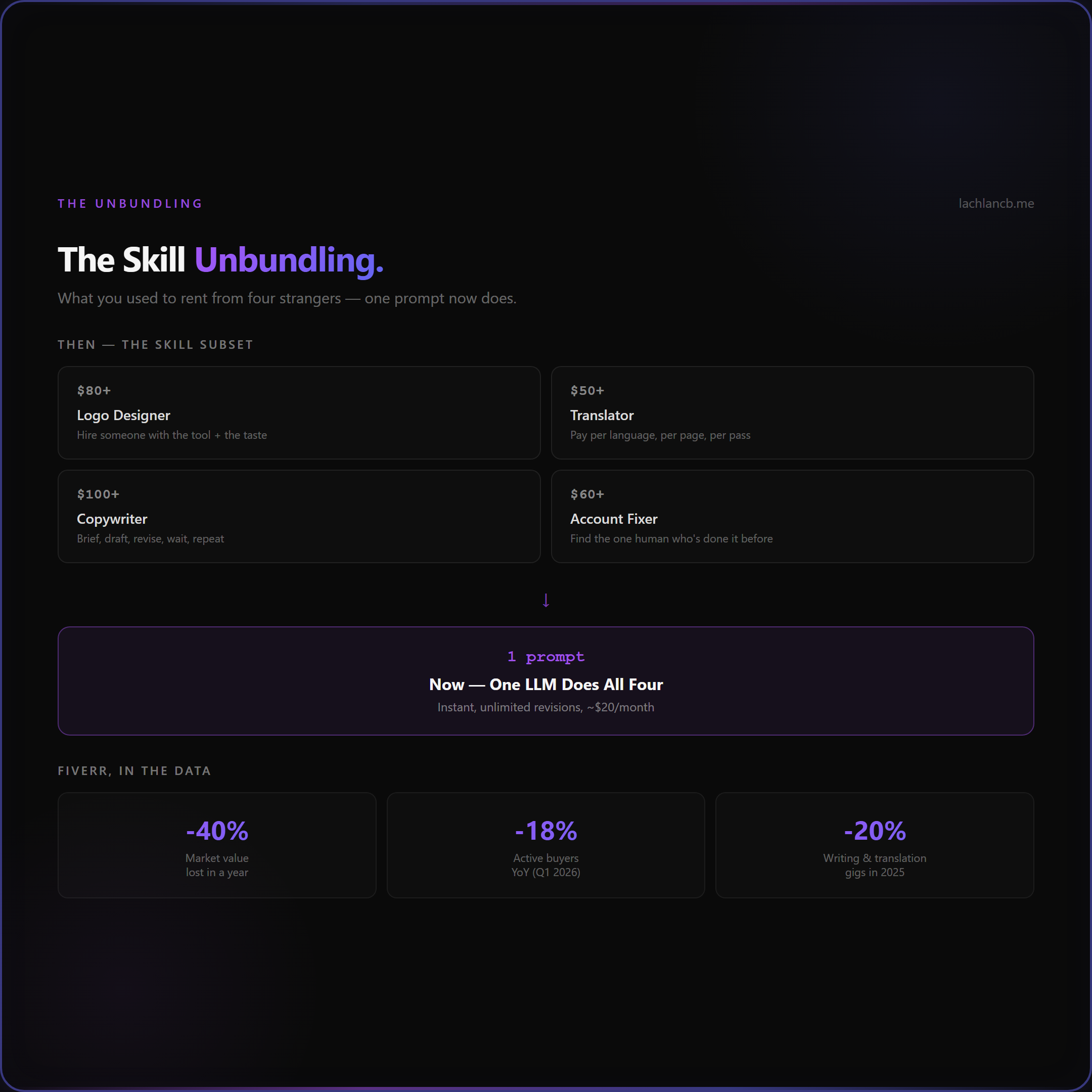
In February 2026, Fiverr lost about 40% of its value in a year, dropping to a market cap near $440 million — barely above its cash pile and below its 2019 IPO price (Calcalist). Its active buyers fell from 3.6 million to 2.9 million in two years. Management guided 2026 revenue down as much as 12% (Fast Company).
The market isn't confused. It's pricing in something most freelancers haven't admitted yet.
TL;DR: Fiverr's low end is being obliterated by LLMs. Writing, translation, and basic design — the cheap, single-skill gigs — fell 20% in 2025. The lesson isn't "Fiverr is doomed." It's that the subset of skills you used to rent from a stranger now collapses into one prompt. That changes what's worth learning.
Fiverr Isn't Collapsing. Its Bottom Is.
Here's the honest version, because the honest version matters.
Fiverr isn't going to zero. Spend per buyer actually rose 15% to $356, and projects over $1,000 grew nearly 23% (Stock Titan). The high end — complex, multi-step, trust-heavy work — is fine.
What's dying is the floor. Fiverr's own SEC filing admits buyers are leaving because of "AI technologies reducing demand for simple and low-skilled services" (SEC.gov). Writing and translation gigs dropped 20% in a single year. The company laid off 25% of its staff and declared a return to "startup mode."
So "Fiverr is dying" is half-true. The accurate version: the cheap-skill layer of the economy is dying, and Fiverr is just where you can watch it happen in real time.
What Actually Died: The Subset of Skills
Five years ago, solving a problem meant assembling a chain of specialists.
I needed a logo — so I hired a logo person. I had an account locked on Amazon — so I found someone who'd dealt with Seller Support before. I needed an article — so I paid a writer. Each problem required renting a specific branch of skill from a specific human, because that skill lived only in their head and their hours.
That chain is what Fiverr sold. Not "design" or "writing" in the abstract — the access to a skill subset you didn't have time to build.
LLMs collapse the chain. The logo, the article, the Amazon appeal letter — one model now does a passable-to-great version of all three, instantly, for the price of a subscription. The skill didn't get more valuable. It got unbundled from the person who used to hold it hostage.
This is the same pattern I wrote about in Skills Are Not Important Anymore. The skill was never the asset. The bottleneck was.
Why This Was Always Going to Happen
The answer-first version: any skill that can be fully described in text was always going to be the first to go.
A logo brief is text. A translation is text-to-text. "Fix my landing page copy" is text. The moment a machine could read and write fluently, every gig that was just a text transformation lost its moat. I watched the same thing happen to web design when a $5,000 homepage became a one-afternoon build.
Look at the timeline. Fiverr's writing and translation categories — once its bread and butter — shrank 20% in 2025 while tools like ChatGPT and Claude went mainstream. That's not slow erosion. That's a whole category getting eaten inside twelve months. When a skill can be copied perfectly and delivered for free, the only people who keep getting paid for it are the ones who were never really selling the raw skill in the first place.
Fiverr's CEO calls the future "human-in-the-loop collaboration." That's a polite way of saying the human is no longer the engine — they're the steering wheel. Useful, but not where the money concentrates.
The uncomfortable truth: if your entire offer is "I have a skill you don't," and that skill fits inside a text box, you're not competing with other freelancers anymore. You're competing with a $20/month tool that never sleeps.
What Survives the Unbundling
So what's left? Three things the model can't unbundle from a person:
- Judgment and taste. Knowing which logo, which angle, which tradeoff. The model gives you ten options; taste picks the one that wins.
- Distribution and trust. Being the person clients already believe. AI can write the email — it can't be the reputation that makes someone open it.
- Sales and relationships. The single hardest thing to automate. I made the full case for this in Why Sales Is the Last Skill AI Can't Touch.
This is why I stopped thinking of myself as someone "good at" a list of things. A skill list is a depreciating asset now — every model release marks more of it down. A position appreciates. The relationships I built, the judgment I earned by shipping, the audience that already trusts me: none of those got cheaper when the latest model dropped. They got more valuable, precisely because everyone else's skills got cheaper around them.
Notice the pattern. What survives isn't a skill — it's a position. Fiverr's own pivot proves it: they're abandoning the skill marketplace and racing to own the "intelligent matching layer." They want to be the trusted middle, not the hands.
You should want the same thing. Stop renting out your hands. Start owning a position.
FAQs
Is Fiverr actually going out of business?
No. It's pivoting hard toward high-value, complex projects and still holds around $300 million in cash. What's collapsing is the low-cost, single-skill end of its marketplace — not the company outright.
Why is AI hurting Fiverr more than other tech companies?
Fiverr earns a cut of each transaction. When LLMs absorb the cheap transactions — writing, translation, basic code — the revenue disappears immediately, not in some distant future. That makes it more exposed than subscription software.
What freelance work is safest from AI?
Work that depends on judgment, trust, and relationships rather than pure execution. Strategy, high-stakes creative direction, sales, and anything requiring accountability for an outcome.
Should I stop learning skills then?
No — but stop collecting skills as the end goal. Learn enough to direct the tools well, then invest the rest of your energy in distribution, judgment, and owning a market position.
The Unbundling Is Here
Fiverr's chart isn't a story about one company. It's a live readout of what happens to anyone whose value is "I have a skill you don't." The people panicking are the ones who were the skill subset. The people winning are the ones who quietly became the position — the judgment, the trust, the relationship — that no prompt can replace.
The unbundling is here. Don't be a gig. Be the reason someone skips the marketplace entirely.

Related: I broke down why the AI agency market only looks flooded — and where the real opening still is — in Everyone's Selling AI Agencies. Almost No One's Selling AI.