·6 min read
Your Next Management System Isn't an App — It's Claude Code
For years the answer to managing your life and business was an app — Notion, Linear, a stack of tabs. That era is ending. Here's why Claude Code is becoming the layer that runs everything.
TL;DR
The way we manage our work and our lives is shifting from apps you operate to a system that operates for you. Notion was the 1.0 of personal management systems. Claude Code is the 2.0 — not because it's another tool, but because it sits above your tools and runs them. Here's what that actually means, and why it matters whether you're a solo operator or a business.
The Word I Kept Using Was "System"
A few years ago, the first time I heard the term "personal management system," it was about Notion. And it made sense Notion sat at the front of everything. It was where I planned my days, tracked my projects, ran my CRM, stored every note. One workspace to support an entire life.
For a long time that was the dream: get everything into one app and you've won.
But there was always a ceiling. Notion held the information. It didn't do anything with it. I was still the engine. Every update, every cross-reference, every "move this from here to there" — that was me, manually, clicking through the same workspace I'd spent months building.
Claude Code broke that ceiling. And once it did, I stopped thinking of my management system as a place I go and started thinking of it as something that works while I'm not looking.
What Changed: From Storing to Doing
The shift is simple to state and hard to overstate: a management system used to be where your information lived. Now it can be the thing that acts on it.
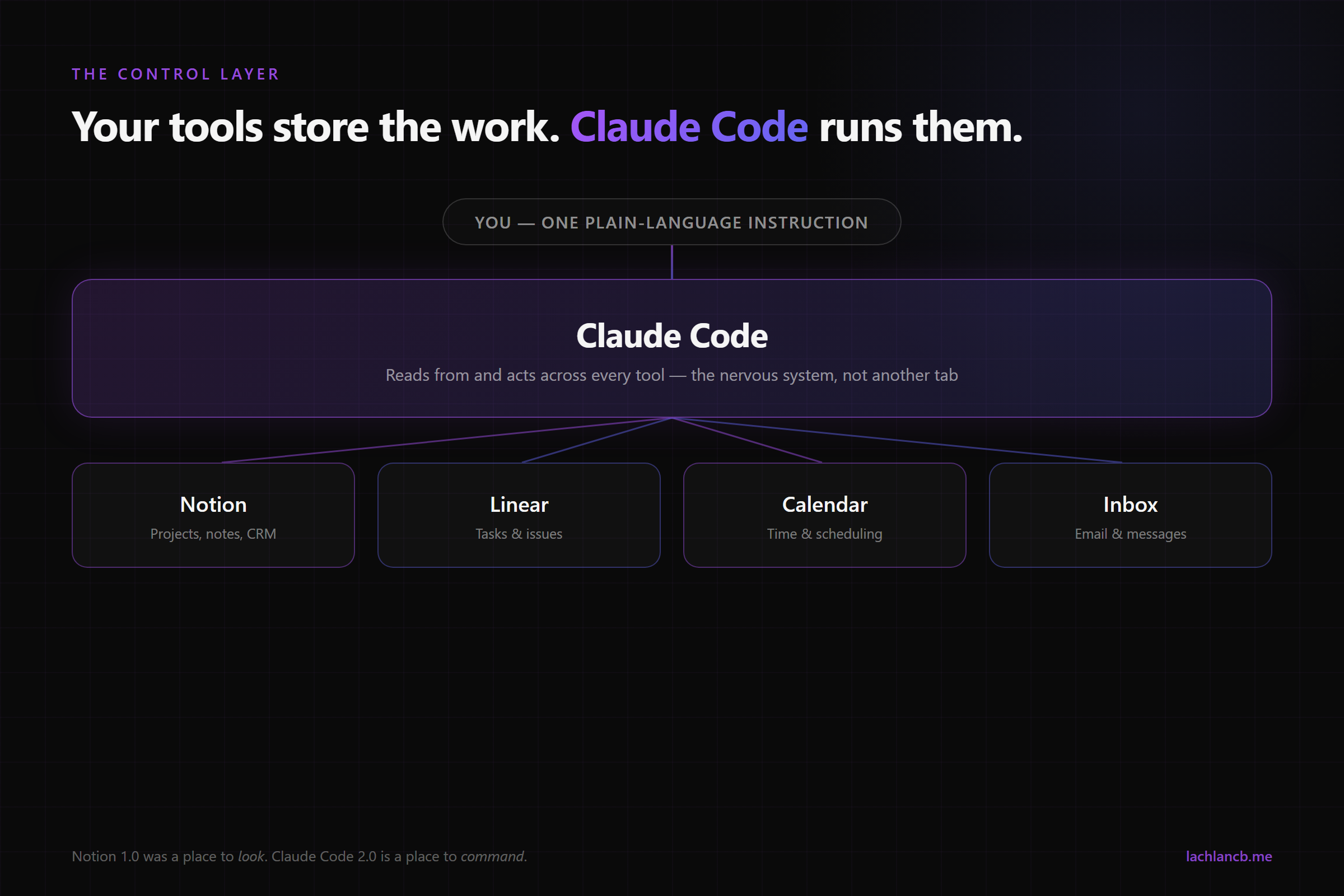
Claude Code doesn't replace Notion or Linear or your calendar. It sits above them and talks to all of them. Ask it to pull this week's open tasks from Linear, cross-check them against your Notion project notes, and draft the client update — and it does. Not in three apps with you as the courier between them. In one place, in one instruction.
That's the actual unlock. The "one place to manage everything" promise that Notion made was real, but it was a place to look. Claude Code is a place to command. The apps become limbs. Claude Code becomes the nervous system.
This is the same principle I wrote about in how I run my entire agency from one terminal window — the terminal isn't the point. The point is that everything routes through a single layer that can read and act across all of it.
Why This Was Impossible Until Recently
Here's the part worth sitting with: this used to require a developer. A good one.
Wiring Notion to talk to Linear, automating a workflow that pulls data from one system and pushes it to another, building something that runs on a schedule without you — that was custom engineering. You either had the technical skill yourself, or you paid someone who did, or it simply didn't get built.
The barrier wasn't ideas. Everyone had ideas for what they'd automate. The barrier was the gap between "I want this" and "I can build this." That gap was years of programming experience wide.
Claude Code collapses that gap. You describe what you want in plain language. It writes the code, connects the services, and runs it. The DevOps layer — the unglamorous plumbing that made automation a specialist's job — is now something you can direct in conversation. Anything you can clearly describe, you can increasingly build.
It's Genuinely Becoming "Automate Anything"
The phrase "you can automate anything now" sounds like hype until you watch where people are actually taking it.
People are automating their WhatsApp — building agents that handle their conversations, triage messages, reply in their own tone. Some are going further and building an AI version of themselves: a system trained on how they think and write, fielding routine communication so the human only handles what genuinely needs them.
Read that again, because it's a real shift in what "management system" even means. We've gone from managing your tasks to managing your communication to, increasingly, delegating slices of your own presence. The system isn't just holding your second brain. It's starting to act as one.
You don't have to go that far to benefit. But the fact that the ceiling is now "a version of you that handles your inbox" tells you how much room there is below it.
Why a Business Needs This, Not Just a Person
For a solo operator, Claude Code as a PMS is leverage — you do the work of a team without hiring one.
For a business, it's something closer to infrastructure. Most companies run on a graveyard of disconnected tools: a project tracker that doesn't talk to the CRM, a CRM that doesn't talk to the docs, and people whose job is quietly to be the glue between them. That glue is expensive, slow, and breaks every time someone leaves.
A system that sits above the tools and moves information between them on command removes that tax. The institutional knowledge stops living only in people's heads and starts living in instructions the system can execute. That's not a productivity hack. That's a durability upgrade — the business gets less fragile.
This is the architect mode made practical: you stop being the person who runs the machine every day and become the person who designs the machine that runs itself.
The Honest Caveat
A management system only amplifies what's already there. Claude Code will run your processes brilliantly — if you have processes. Point it at chaos and you get faster chaos.
The work of thinking clearly about how your life and business should run doesn't disappear. It becomes more valuable, because now clear thinking converts directly into a working system instead of a nice-looking Notion page you never act on. The tool rewards operators who know what they want and exposes the ones who don't.
FAQs
What does "Claude Code as a PMS" actually mean?
It means using Claude Code as the layer that sits above your existing tools — Notion, Linear, your calendar, your inbox — reading from them and acting on them through plain-language instructions, rather than you manually operating each app separately.
Does Claude Code replace Notion or Linear?
No. It connects to them. Your tools still store the data and structure the work. Claude Code becomes the control layer that moves information between them and executes tasks across all of them at once.
Do I need to be technical to use Claude Code this way?
Less than you'd think. The whole shift is that work which used to require a developer — connecting services, building automations, scheduling tasks — can now be described in plain language. You direct it; it builds it.
What can you realistically automate with it?
Project updates, cross-tool reporting, scheduled workflows, message triage, content drafting — and increasingly, communication itself. People are automating WhatsApp replies and building AI versions of themselves to handle routine conversations.
Is this overkill for one person?
The opposite. A solo operator gets the most relative leverage — it lets one person run the operation of a small team. For a business, it's infrastructure that makes the company less dependent on any single person being the glue.